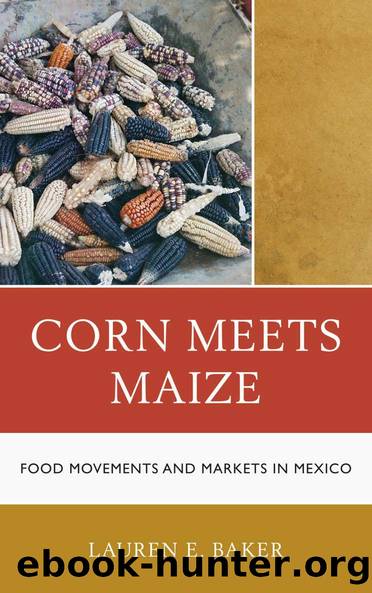
Corn Meets Maize: Food Movements and Markets in Mexico by Lauren E. Baker
Author:Lauren E. Baker [Baker, Lauren E.]
Language: eng
Format: azw3
Publisher: Rowman & Littlefield Publishers
Published: 2012-11-28T16:00:00+00:00
4
Itanoní Tortillería
The reinvention of eating a taco in the city made with peasant maize could be one of the many social possibilities that would help reactivate “marginalized” agricultures. If the claim for social development policies were to be reoriented as a means to enable peasant societies to maintain their agrodiversity, their maize could be added to consumption processes of markets beyond local borders.
—Vizcarra Bordi 2006, 104
The Rich Oaxaca Context
The Itanoní Tortillería links urban eaters in Oaxaca, Mexico, with campesino farmers around the state. It is precisely, as Ivonne Vizcarra Bordi notes in the opening quote, this vision of reactivating campesino agriculture as a strategy to conserve agrodiversity that motivates the owners, Amado Ramírez Leyva and Gabriela Fernández Orantes. This chapter begins by describing Oaxaca in order to contextualize the work of Itanoní. The following sections describe the supply chain, the motivations of the owners, and their work with campesinos. The project provides a way to elaborate the notion of biocultural agrifood relations and explore its epistemological roots.
Oaxaca is famous for its ecological and cultural diversity. Topologically the state spans from the Pacific Ocean to the Sierra Madre mountains that reach more than 2,700 meters (over 8,800 feet) in some areas. The mountainous characteristics of the state means that the ecology varies wildly, from dry savannah to tropical cloud forest to coastal beaches. There are seventeen distinct ethnolinguistic indigenous groups that live in the state (Barabas, Bartolome, and Maldonado 2003), speaking over 104 languages and dialects (Toledo 2001). The ethnocultural diversity and topographical variation mean Oaxaca is the Mexican state with the most biodiversity. Oaxaca is one of the regional centers of origin in Mexico of maize, chili peppers, and squash. It also means that Oaxaca has a large number of small-scale campesino farmers who farm over 7 million hectares of land, almost two-thirds of the state’s territory (Toledo 2001, 476).
Oaxaca is the second poorest state in Mexico. Agriculture employs 40 percent of Oaxaca’s working population. This production is characterized by small-scale family enterprises growing for household consumption. A small amount of surplus production is taken to the market. The land is primarily tilled by bullock, but farmers sometimes pay to have a tractorista till their land. Harvesting is done by hand. Oaxaca has a high degree of land tenure fragmentation, with individual parcels ranging from two rows to five hectares (Badstue 2006, 57–75).
Although agriculture remains the key component of household economies in Oaxaca, off-farm work and remittances are also important sources of income. Over 150,000 Oaxacans leave the state to work in Northwest Mexico or the United States each year, and over 1 million Oaxacans live in the United States (CEAMO 2002 in Badstue 2006, 57–75).
Oaxaca City is known as the cultural and culinary center of Mexico. Its colonial architecture, vibrant zocalo, art galleries, artisanal crafts, cafés, and restaurants are attractive to tourists. Over the past ten years a number of cooking schools have opened in Oaxaca, making the city a popular place to come and learn to cook Mexican specialties such as mole.
Download
This site does not store any files on its server. We only index and link to content provided by other sites. Please contact the content providers to delete copyright contents if any and email us, we'll remove relevant links or contents immediately.
| Anthropology | Archaeology |
| Philosophy | Politics & Government |
| Social Sciences | Sociology |
| Women's Studies |
Cecilia; Or, Memoirs of an Heiress — Volume 1 by Fanny Burney(32558)
The Great Music City by Andrea Baker(32019)
Cecilia; Or, Memoirs of an Heiress — Volume 2 by Fanny Burney(31956)
Cecilia; Or, Memoirs of an Heiress — Volume 3 by Fanny Burney(31942)
We're Going to Need More Wine by Gabrielle Union(19046)
All the Missing Girls by Megan Miranda(16027)
Pimp by Iceberg Slim(14507)
For the Love of Europe by Rick Steves(14121)
Bombshells: Glamour Girls of a Lifetime by Sullivan Steve(14075)
Talking to Strangers by Malcolm Gladwell(13370)
Norse Mythology by Gaiman Neil(13365)
Fifty Shades Freed by E L James(13241)
Mindhunter: Inside the FBI's Elite Serial Crime Unit by John E. Douglas & Mark Olshaker(9343)
Crazy Rich Asians by Kevin Kwan(9292)
The Lost Art of Listening by Michael P. Nichols(7506)
Enlightenment Now: The Case for Reason, Science, Humanism, and Progress by Steven Pinker(7313)
The Four Agreements by Don Miguel Ruiz(6765)
Bad Blood by John Carreyrou(6621)
Weapons of Math Destruction by Cathy O'Neil(6280)
